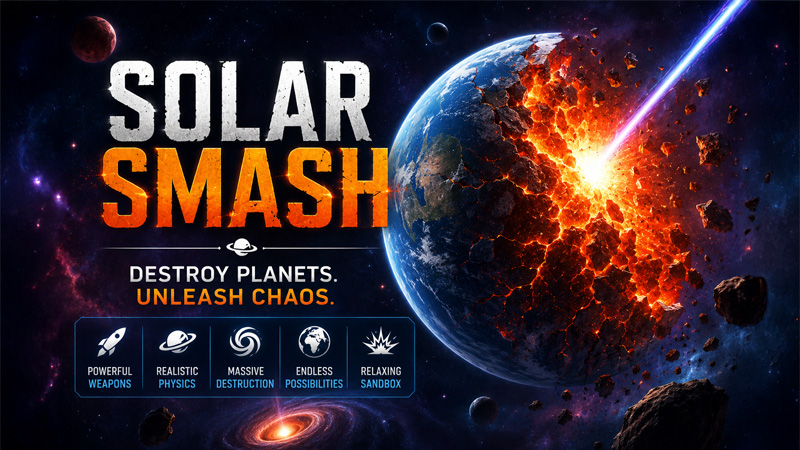
Some games reward your patience. Some reward your reflexes. Solar Smash rewards none of that - it just hands you a black hole and points at Jupiter. It's a planetary destruction simulator, and I mean that with complete sincerity. There are no levels to clear, no enemies to defeat, no progression to grind. There is a planet, there is an arsenal of catastrophic weapons, and there is you, deciding which combination you would like to see play out across the next thirty seconds.
I added Solar Smash to Classroom Connect because I was curious whether the appeal would survive being moved out of its mobile home and into a browser window. It absolutely does. If anything, the larger viewport makes the destruction more spectacular.
Solar Smash is available free on Classroom Connect. No download, no account - just open and start blowing things up.
Destroy planets with lasers, black holes, asteroid storms, and alien invasions. The most cathartic sandbox in browser gaming.
Why Solar Smash Works So Well
The premise is so straightforward that explaining it takes about ten seconds. You have a planet floating in space. You have a panel of weapons. You pick a weapon, aim at the planet, and watch what happens. There is no failure state, no time limit, no objectives. The game is essentially a physics-driven art toy where the medium is destruction.
What makes this work - what stops it from getting boring after thirty seconds - is the variety in the arsenal and the genuine quality of the physics simulation. A black hole does not just delete a planet; it pulls the planet's mass inward over several seconds, distorting its shape, before collapsing it into a singularity. A laser does not flash and end the planet; it carves a glowing line across the surface that you can watch propagate as you sweep the beam. Each weapon has a distinct behaviour, and the curiosity to see what each one looks like - and how they interact when you combine them - is what gives Solar Smash unexpected longevity.
The Weapon Arsenal
Solar Smash gives you a set of distinct destruction methods, and the right way to play is to try all of them rather than just hammering the most powerful option. Each weapon produces a visually different outcome, and treating the game as a curiosity rather than a contest gets you the most out of it.
- Lasers - the precision instrument. Carve glowing trenches across the surface, slice the planet in half, or cut continents off cleanly.
- Nuclear missiles - the workhorse weapon. Each impact creates a spreading mushroom cloud and a glowing crater. Stack them and the entire surface starts to burn.
- Black holes - the showstopper. Place one near the planet and watch the gravitational distortion warp the surface before the collapse pulls everything inward.
- Asteroid storms - environmental destruction. Rocks rain from above, cratering the surface and ejecting debris into orbit.
- Alien invasions - the slowest and most interesting. Smaller vessels deploy across the surface and tunnel into the planet from multiple points.
- Solar flares and other ranged effects - the cinematic options. Less precise than direct weapons, but visually impressive when applied to the right target.
Choose Your Planet
The same arsenal applied to different planets produces dramatically different results, and this is where Solar Smash gets surprisingly experimental. Earth is the default target and the most familiar - watching weapons reshape recognisable continents has its own specific appeal. Mars feels different because the lack of atmosphere makes impact effects look starker. Jupiter is the one to try when you want to feel the limits of your weapons - a black hole that obliterates Earth barely registers against Jupiter's mass, and a laser that would slice Earth in half just scratches Jupiter's surface.
Cycling through planets to see how the same weapon behaves at different scales is one of the most genuinely interesting things you can do in the game. There is no in-game prompt that suggests this; you just notice that the alien invasion looks completely different when applied to a gas giant versus a terrestrial planet, and from there the curiosity drives the rest of the session.
Combine weapons rather than firing them in isolation. Drop a black hole, then fire missiles into the area being pulled in - the gravitational distortion bends the missile trajectories in ways the standard physics doesn't normally produce.
How to Get the Most Out of It
Solar Smash is best treated as a sandbox rather than a game. There is no correct way to play and no rewards for efficiency, so the players who get the most out of it are the ones who experiment with combinations and angles rather than the ones who try to maximise destruction speed. A few things that make sessions more interesting:
- Rotate the planet between attacks. Damage one hemisphere, spin it around, attack the other side - the cumulative effect across the full surface is more dramatic than concentrated damage in one spot.
- Try the slow weapons first. Black holes and alien invasions take time to play out, which is part of their appeal. The instinct to skip ahead to the next weapon misses what these are doing.
- Switch planets mid-session. The visual variety from changing target keeps the experience fresh in a way that staying on Earth for the whole session does not.
- Watch what happens after you stop firing. The physics continues - debris fields settle, fires spread, gravitational effects play out. Some of the best visual moments come after you've stopped intervening.
Why It Belongs in the Browser
Solar Smash started as a mobile game and the touch interface obviously suits the aiming. What works on a browser is the bigger screen - the destruction is meant to be watched, and watching it on a laptop monitor is more satisfying than watching it on a phone. The browser version also drops the friction of installation, which matters for a game whose appeal is largely impulse-driven. You are not going to download an app to spend ten minutes destroying planets. You will absolutely click a tab to do the same thing.
It's the kind of game I keep open in a background tab and return to when I need a few minutes of zero-stakes spectacle between actual work. There is something genuinely useful about an interaction that has no failure state, no consequences, and no goals. Solar Smash provides that consistently, and the variety in its arsenal means I'm rarely doing the same thing twice.
Open it on Classroom Connect, pick the planet that's bothering you most today, and start with the black hole. The rest sorts itself out.