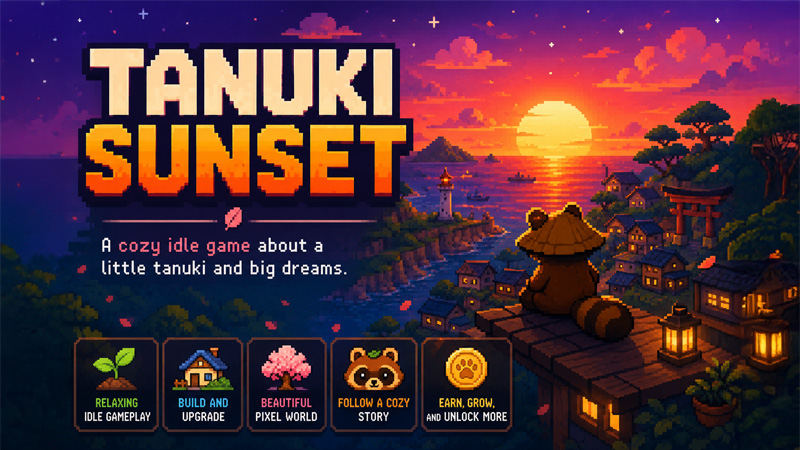
Most browser games want something from you. Reflexes, attention, competitive instincts, score-chasing willpower. Tanuki Sunset wants none of that. It wants you to glide down a mountain road as a raccoon on a longboard while the sun sets and a lo-fi beat plays softly in the background. That is the entire premise. It is also one of the best things in the Classroom Connect library.
I keep this one bookmarked for a specific use case - the moments between intensive work where I need a few minutes of mental reset. Scrolling a feed does not provide that. Watching a short video does not provide that. Tanuki Sunset, somehow, does. The combination of slow movement, warm colour palette, and unhurried music creates a small pocket of calm that I have not found in any other browser game.
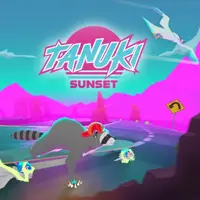
Glide down a mountain road as a raccoon on a longboard. Sunset gradients, lo-fi soundtrack, zero stress.
What You Actually Do
You play a raccoon riding a longboard down a winding mountain road. The left and right arrow keys lean the board into curves. Moving toward the road edges on straight sections builds speed; staying near the centre slows you down. Doughnuts scattered across the lane are the collectibles - grab them as you pass to accumulate score and unlock cosmetic items over time. That is the entire game.
There are no enemies. There is no clock. Drifting off the road edge is gently corrected rather than punished. The game cannot really be lost in any meaningful sense. The challenge, if you want to call it that, is in carving smoother lines and collecting more doughnuts than you did last run. It is a game built around flow, not friction.
Tanuki Sunset is available free on Classroom Connect. Arrow keys to lean - that's the whole control scheme.
Why the Vibe Is the Whole Point
Most games are designed to capture and hold your attention through tension. Will I beat the level? Will I get the high score? Will I survive the next wave? Tanuki Sunset removes that engine entirely. There is nothing tense to capture. The road continues, the sun sets, the music plays. The interaction loop is hypnotic rather than exciting.
The art direction commits to this completely. The sunset palette - peach, amber, deep purple, soft pink - is warm in a way that almost no other browser game attempts. The mountain silhouettes scroll past at a tempo that matches the music. The raccoon character animates with a slight bob that syncs to the beat. None of these details are critical to the gameplay, but together they produce a coherent atmosphere that the gameplay then sits inside.
The Carve
If you want to engage with Tanuki Sunset as a game rather than purely as a vibe, the central skill is learning to carve. Real longboarders carve into curves by leaning early and committing through the turn rather than steering sharply at the apex. The game models this. Pressing the arrow key just before the curve and holding the lean through the bend produces smooth, fast lines. Mashing the arrow key in short bursts at the apex produces jagged lines that bleed speed.
The difference between a player who has internalised the carve and a player who is still steering reactively is significant. The carving player flows through the course, collects doughnuts in clean sweeps, and carries momentum from curve to curve. The reactive player corrects constantly, misses doughnuts, and never quite settles into the rhythm the game is built around. Once carving clicks, the game opens up into something genuinely beautiful.
What to Listen For
The soundtrack is essential. Tanuki Sunset's lo-fi instrumental music is not background noise - it sets the tempo your movement naturally syncs to, and playing the game with the sound off removes the most important sensory layer of the experience. The carving even feels different when the audio is on. There is a subtle musicality to the way successful runs play out, where your inputs end up timed roughly to the rhythm without you consciously trying.
Headphones recommended. The lo-fi soundtrack carries through small speakers but the warmth of it really lands in headphones, and that warmth is most of the appeal.
When to Play It
Tanuki Sunset is not the game to open when you have ten free minutes and want to feel competitive. It is the game to open when you have ten free minutes and need to decompress. Between long blocks of work, after a stressful conversation, before bed if you keep your laptop nearby - those are the moments where this specific game does something useful that no other browser game in the catalogue does.
- Between intensive work sessions when your attention is fried but you don't want to fully disengage from the screen.
- When you want music and visuals more than you want gameplay - it works as ambient atmosphere even if you are barely steering.
- After a tense session of any other competitive game, as a deliberate cool-down.
- On long evenings when you want something gentle running in a window while you read or message a friend.
Why It Earns Its Place
I think about Tanuki Sunset more than its mechanics warrant, and I think the reason is that browser games almost universally optimise for engagement through tension. Most of them want to keep you locked in by making you anxious about losing or eager to win. Tanuki Sunset is one of the few that earns its hold on you by being calm. It's a game that I leave open in a tab and return to specifically because the world inside it is gentler than most of what's outside it.
If you have not tried it, give it a single five-minute run with the sound on. The first thirty seconds will feel slight. By the third minute the rhythm of it will catch you, and by the time the run ends you will probably start another. Open it on Classroom Connect and go for a ride - the road is waiting and the sun is exactly where you left it.